November 15th, 2024 | Comments Off on Trans Awareness Month
November is Trans Awareness Month and to kick it off I wanted to share this clip of Laverne Cox https://youtu.be/qF417t9WaZk from the Masked Singer. She is a talent! I love that she talked about healing her trauma and spoke to what it is like being a black trans woman in America today. Most of all I LOVED her voice! Chaka Khan watch out.
Women in trans awareness
It is so important to include trans women in women’s spaces. Laverne has been a champion for trans women, check out her speech at Variety’s Power of Women from 2016 here: https://youtu.be/pPY2ZCkT9p0.
Use inclusive language. Say “women” instead of adding phrases like “female-identifying people” which can imply that trans women are not fully considered women.
Be proactive in inclusion. Clearly state that all women, including trans women, are welcome.
Educate yourself and others. Understand the experiences of trans women and address any misconceptions about their identities.
Address concerns with sensitivity. If someone has concerns about trans women being in a women’s space, listen respectfully and address them with factual information and a focus on creating a safe environment for everyone.
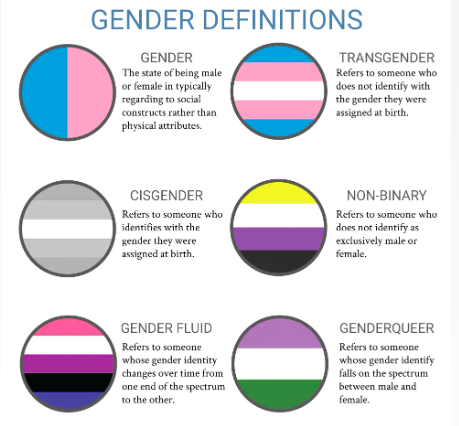
Important gender identifications including trans
Potential challenges to consider.
Transphobia. Some individuals might hold negative views towards trans women, which can create a hostile environment.
Misconceptions about gender. Some people may not understand that trans women are women and might need education on this topic.
Privacy concerns. Addressing concerns about privacy in shared spaces like bathrooms can be important, but should not be used to exclude trans women
There are soooo many trans women activists, I challenge you to look one up and learn about their history and the work they do. Also, November 20 is the transgender day of remembrance, it is an annual observance that honors the memory of the transgender people whose lives were lost in acts of anti-transgender violence. You could consider looking for a local vigil. Vigils are typically hosted by local transgender advocates or LGBTQ organizations, and held at community centers, parks, places of worship, and other venues.
October 15th, 2024 | Comments Off on Political Trauma
Note about Halloween (not related to political trauma):
Special note: As Halloween approaches, I want to remind everyone of what the blue and teal pumpkins represent. If a trick-or-treater comes to your door with a blue pumpkin, please know it represents the carrier is on the autism spectrum and they may not be able to say “trick or treat” or “thank you”. The teal pumpkin represents that the carrier has food allergies. If you have a teal pumpkin out the trick or treater will know you have nonfood options for them to choose. Happy haunting!
Trick-or-treaters may come to your house with non-orange colored pumpkins. To make it a fun & safe experience for all children, we hope you’ll find this guide helpful!
Do any of these apply to you in relation to experiencing political trauma?
The article lists 14 signs you may be experiencing political trauma: 1. Constant feeling of being on edge 2. Difficulty trusting political leaders 3. Increased anxiety during news coverage 4. Feeling powerless to affect change 5. Avoidance of political discussions 6. Difficulty sleeping due to stress 7. Persistent feelings of anger or frustration 8. Heightened sensitivity to political events 9. Physical symptoms like headaches and fatigue 10. Estrangement from friends or family over political views 11. Intrusive thoughts about political scenarios 12. Loss of interest in previously enjoyed activities 13. Emotional numbness or detachment 14. Increased use of substances to cope
If you are experiencing any of these signs reach out to a mental health therapist for help. A therapist’s office is a safe space to discuss how you are feeling; the therapist is an unbiased ear. If you ever feel not safe discussing any topic it is OK to seek a different therapist. Political discussions have traditionally been taboo but we need to be talking about how current day politics are affecting our mental health. A common discussion clients have in my office are fears for safety due to the political climate; work with your therapist to develop a plan for safety if you are feeling this way.
Jen’s suggestions on dealing with political trauma…
It is important to be aware of what is happening around us and not take a “head in the sand” approach. However, my suggestion is to limit exposure to political discourse by reducing the amount of time you watch or listen to the news, gently change topics when friends or co-workers discuss politics, and find an opportunity to contribute to a cause you are passionate about. This boosts feeling that you are making a positive change.
September 12th, 2024 | Comments Off on Suicide Awareness
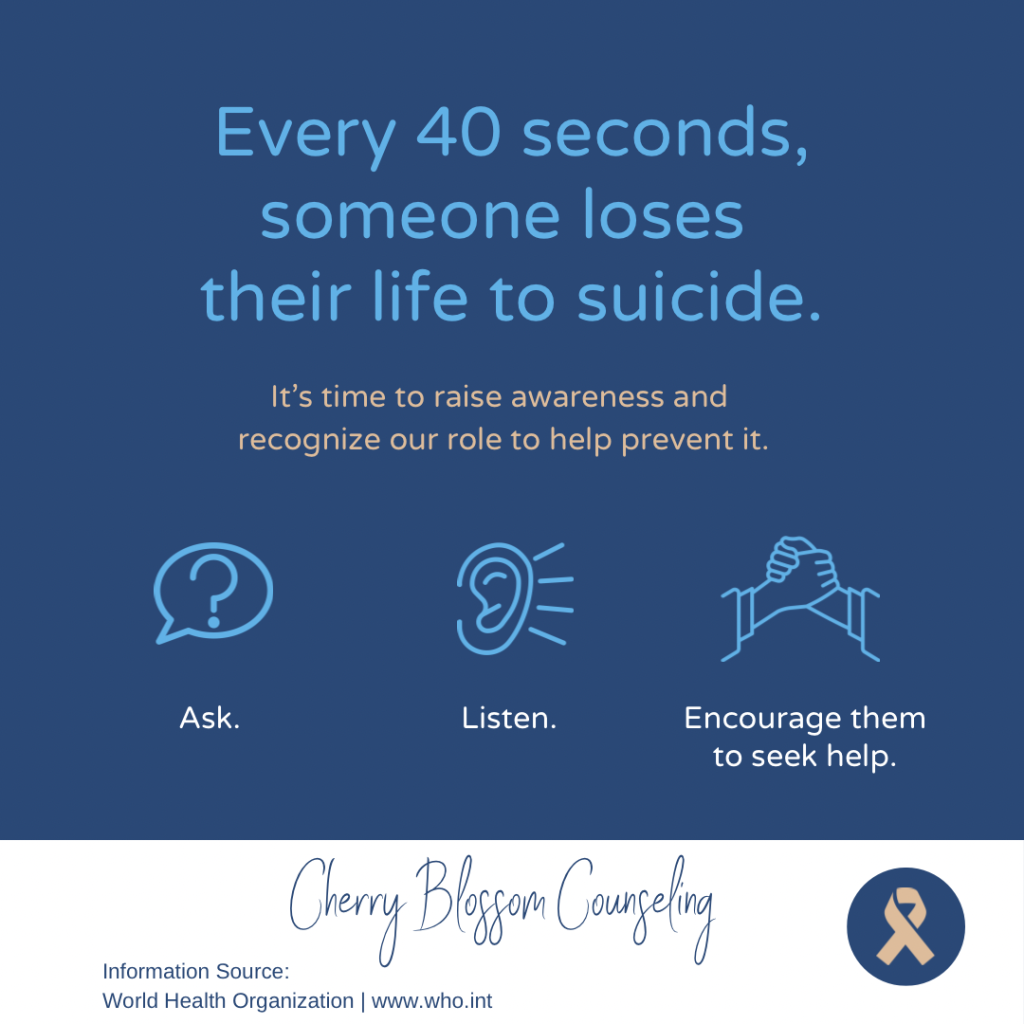
September is National Suicide Awareness month. Thoughts of suicide can be distressing but it is more common than you might think. Help is available, text 741741, call or text 988, call 911. You can also reach out to the Trevor Project through their website at www.thetrevorproject.org. Cherry Blossom Counseling is here to help you through this difficult time with kindness and nonjudgement, give us a call at (330) 221-2388 to schedule an appointment.
Myth 1: Talking about suicide increases the chance a person will act on it.
Fact: Talking about suicide may reduce, rather than increase, suicidal ideation. It improves mental health-related outcomes and the likelihood that the person would seek treatment. Having suicide awareness and opening this conversation helps people find an alternative view of their existing circumstances. If someone is in crisis or depressed, asking if he or she is thinking about suicide can help, so don’t hesitate to start the conversation.
Myth 2: People who talk about suicide are just seeking attention.
Fact: People who die from suicide have often told someone about not wanting to live anymore or they do not see the future. It’s always important to take seriously anybody who talks about feeling suicidal. Suicide awareness can be tricky. It’s important to be kind and sensitive, and ask direct questions such as: “Are you thinking about hurting yourself?” “Are you thinking about suicide?” or “Do you have access to weapons or things that can be used as weapons to harm yourself?”
Myth 3: Suicide can’t be prevented.
Fact: Suicide is preventable but unpredictable. Most people who contemplate suicide, often experience intense emotional pain, hopelessness and have a negative view of life or their futures. Suicide is a product of genes, mental health illnesses and environmental risk factors. Interventions targeted to treat psychiatric and substance use illnesses could save lives.
Myth 4: People who take their own lives are selfish, cowards or weak.
Fact: People do not die of suicide by choice. Often, people who die of suicide experience significant emotional pain and find it difficult to consider different views or see a way out of their situation. Even though the reasons behind suicide are quite complex, frequently suicide is associated with psychiatric illnesses, such as depression, anxiety, bipolar disorder, schizophrenia and substance use.
Myth 5: Teenagers and college students are the most at risk for suicide.
Fact: The suicide rate for this age group is below the national average, and suicide risk increases with age. The age group with the highest suicide rate in the U.S. is men and women between 45 and 64. Though particular groups may be at higher risk, suicide is a problem among all ages and groups.
Myth 6: Barriers to bridges, safe firearm storage and other actions to reduce access to lethal methods of suicide don’t work.
Fact: Limiting access to lethal means, such as firearms, is one of the simplest strategies to decrease the chances of suicide. Many suicide attempts are a result of impulsive decisions. Therefore, separating someone from a lethal means could provide a person some time to think before doing harm o themselves.
Myth 7: Suicide always occurs without warning.
Fact: There are almost always warning signs before a suicide attempt.
Talking about suicide — making statements such as “I’m going to kill myself,” “I wish I were dead” or “I wish I hadn’t been born.”
Getting the means to take your own life, such as buying a gun or stockpiling pills.
Withdrawing from social contact and wanting to be left alone.
Having mood swings, such as being emotionally high one day and deeply discouraged the next.
Being preoccupied with death, dying or violence.
Feeling trapped or hopeless about a situation.
Increasing use of alcohol or drugs.
Changing normal routine, including eating or sleeping patterns.
Doing risky or self-destructive things, such as using drugs or driving recklessly.
Giving away belongings or getting affairs in order when there is no other logical explanation for doing this.
Saying goodbye to people as if they won’t be seen again.
Developing personality changes or being severely anxious or agitated, particularly when experiencing some of the warning signs listed above.
Myth 8: Talk therapy and medications don’t work.
Fact: Treatment can and does work. One of the best ways to prevent suicide is by getting treatment for mental illnesses, such as depression, bipolar illness or substance abuse, and learning ways to cope with problems. Finding the best treatment can take some time, and the right treatment can greatly reduce the risk of suicide.
If a friend or loved one talks or behaves in a way that makes you believe he or she might attempt suicide, don’t try to handle the situation alone. Suicide awareness can happen with:
Get help from a trained professional as quickly as possible. The person may need to be hospitalized until the suicidal crisis has passed.
Encourage the person to call a suicide hotline number. In the U.S., call the 988 Suicide and Crisis Lifeline at 988 or chat at 988lifeline.org to reach a trained counselor. Call 988 and press “1” to reach the Veterans Crisis Line.
You’re not responsible for preventing someone from taking their own life, but your intervention and suicide awareness may help them see that other options are available to stay safe and get treatment.